The following article, reprinted from the June 1955 issue of The Motor, was originally reprinted in the magazine of the Ford Sidevalve Owners Club sometime in the mid 1980s. The extract had been submitted by Sam Batte, an Albatross owner and Ford Sidevalve enthusiast. His profile and letter of explanation appears below the article.
Reprinted by courtesy
of: THE MOTOR. Issue 734, June 8 1955 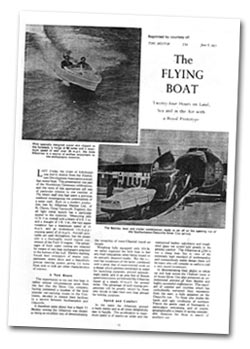
The FLYING BOAT
Twenty-four Hours on Land,
Sea and in the Air with a Royal Prototype
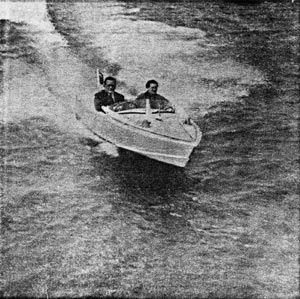
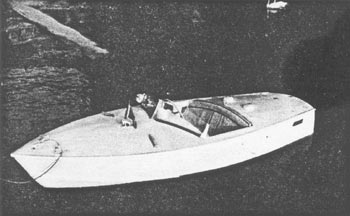
Last Friday the Duke of Edinburgh was due to receive from the Aluminium Development Association a small, fast motor boat. The presentation was part of the Aluminium Centenary celebrations, and the news of this appropriate gift was of particular interest to one member of The Motor staff who had spent a previous weekend investigating the potentialities of a sister craft. Built on a modern production line by Albatross Marine Ltd., of St. Olaves, Great Yarmouth, England, this all light metal launch has a particular appeal to the motorist. Measuring only 12 ft. 9 in. overall with a beam of 4 ft. 7 in. and a draught of 1 ft. 3 in., the two-seater runabout has a maximum speed of 34 m.p.h. and an economical (16 m.p.g.) cruising speed of 25 m.p.h. Aircraft principles are used throughout, but the power unit is a thoroughly sound marine conversion of the Ford 10 engine. The advantages of fresh water cooling are retained by means of two heat exchangers attached to the bottom of the hull. Electric starting, forced feed ventilation of engine compartment, direct drive and a beautifully precise steering system giving 2.6 turns from lock to lock are other characteristics of interest.
  |
||
|
A New Route
The opportunity to try out this boat in rather unique circumstances arose from the fact that the Silver City company, having pioneered a number of the most popular car-carrying routes to the Continent, decided to extend their facilities to a service between Southampton and Deauville.
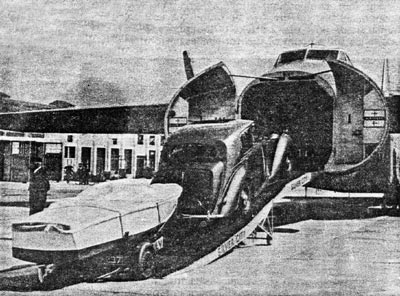
It therefore came about that a Mark VI Bentley towing the Albatross was chosen as being an excellent way of demonstrating the versatility of trans-Channel travel air freight.
Weighing fully equipped only 570 lb. we rather expected the little boat to feel any road inequalities when being towed on its specially designed trailer. But the torsion bar suspension of the latter, combined with a great deal of experimental work on a design which permits immersion in water for launching purposes, proved astonishingly stable, and in an area free of British speed restrictions we followed the Albatross equipe at a steady 80 m.p.h. for several miles. The advantage of such towing propensities will be greatly valued by those who decide to take their own boat abroad for holiday purposes.
Speed and Comfort
|
|
||
|
In the water the Albatross proved a ready starter and at all times delightfully easy to handle. The acceleration to maximum speed is of sports-car order and the waterproof leather upholstery and toughened glass vee screen add greatly to the general comfort. The Albatross at £550 is not a cheap boat, but in view of the extremely high standard of workmanship and outstandingly stable design there will be many who will consider so useful a craft a very sound investment.
In demonstrating their ability to whisk car and boat across the Channel twice in 24 hours Silver City also presented an unintentional preview of their flexible and highly successful organization. The standard of comfort and courtesy which has undoubtedly sustained their reputation from the start, is fully apparent on the Deauville run. To those who dislike the harsh and ugly conditions of northern France the gentle coast of Normandy is particularly welcoming, and of course, geographically a means of saving considerable distances for those in search of southern sun.
MEMBERS PROFILE
 Sam
Batte — lives by the sea in Portpatrick, Stranraer and has become
involved with sidevalve powered boats. He writes:
Sam
Batte — lives by the sea in Portpatrick, Stranraer and has become
involved with sidevalve powered boats. He writes:
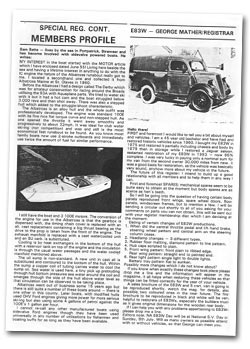
MY INTEREST in the boat started with the MOTOR article which I have enclosed dated June 55! Living here beside the sea and having a lifetime interest in anything to do with the 1C engine the nature of the Albatross runabout really got to me. I located a secondhand one and collected it from Albatross Marine at St. Olaves in 1960.
Before the Albatross I had a design called The Derby which was for amateur construction for racing around the Broads utilising the 93A with Aquaplane parts. We tried to water ski with it but it had a hot cam and the boat struggled below 3,000 revs and then shot away. There was also a stepped hull which added to the struggle/shoot characteristic.
The Albatross is an alloy hull and the whole outfit was professionally developed. The engine was standard 100E with its fine nice flat torque curve and non-stepped hull. As one opened the throttle it went away smoothly and progressively to about 32mph. It was ideal for club water ski-ing (not competition) and was and still is the most economical fast runabout to be found. As you know most family boats now use 2-stroke outboards and immediately use twice the amount of fuel for similar performance.
 |
|
|
|
I still have the boat and three 100E motors. The conversion of the engine for use in the Albatross is that the gearbox is dispensed with, the timing chain cover is replaced with an ali. cast replacement containing a big thrust bearing as the drive to the prop is taken from the front of the engine. The exhaust manifold is replaced with a cast water-cooled unit and an SU carb. is substituted.
Cooling is by heat exchangers in the bottom of the hull with a reservoir tank on top of the engine and the circulation is through the usual water passages and the water-cooled manifold mentioned above.
The oil sump is non-standard. A new unit in cast ali is substituted and contoured to the bottom of the hull. Within the sump a copper coil of tubing carries water to cool the sump oil. Sea water is used here, a tiny pick up protruding through hull bottom pressures sea water around the coil and emerges through the side of the hull above water level so that circulation can be observed to be taking place.
Albatross went out of business some 15 years ago but there are still quite a number of these boats around — there is one other in this county. Later boats, with modified hulls used OHV Ford engines giving more power for more serious ski-ing but also using some 4 gallons of petrol against the 100E's 1 gallon per hour.
I cannot recall any other manufactured boats using sidevalve Ford engines* though they have been used universally in any number of utilisations by fishermen and boating buffs for as long as they have been available.
* Obviously Sam hadn't encountered a Simmonds!
Thanks
to the Ford Sidevalve Owners Club
for their kind permission to reproduce this article

Space
to host this article has kindly been given by the Latham
Sports Register
and the page was created in response to a posting on www.oldspeedboats.co.uk