| 
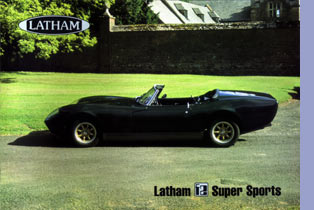 We
reproduce here the entire text and page views of the
Latham F2 Super Sports brochure. It was a lavish production,
running to eight pages A4 landscape, and was produced
to a high standard. Printing was in full colour throughout
and every page was generously illustrated with photographs
and drawings. We
reproduce here the entire text and page views of the
Latham F2 Super Sports brochure. It was a lavish production,
running to eight pages A4 landscape, and was produced
to a high standard. Printing was in full colour throughout
and every page was generously illustrated with photographs
and drawings.
At
the time it was leagues ahead of almost anything else
being produced for the component car market, and even
if the sales of Latham sports cars didn't take off like
startled rabbits, it shocked enough of the car's competitors
to ensure that the days of the photocopied sheet and
stapled photo were consigned to the waste bin.
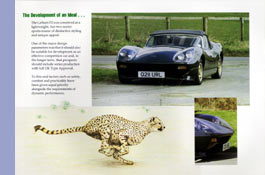 The
Development of an Ideal... The
Development of an Ideal...
The
Latham F2 was conceived as a lightweight, fast two-seater
sports-tourer of distinctive styling and unique appeal.
One of the major design parameters was that it should
also be suitable for development as an effective competition
car and, in the longer term, that prospects should include
series production with full UK Type Approval.
To this end factors such as safety, comfort and practicality
have been given equal priority alongside the requirements
of dynamic performance.
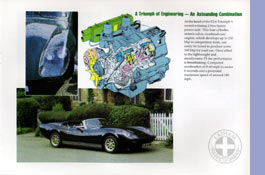 A
Triumph of Engineering — An Astounding Combination A
Triumph of Engineering — An Astounding Combination
At the heart of the F2 is Triumph's award-winning 2
litre Sprint power unit. This four cylinder, sixteen
valve, overhead-cam engine, which develops up to 230
bhp in competition form, can easily be tuned to produce
some 160 bhp for road use.
Once
allied to the lightweight and aerodynamic F2 the performance
is breathtaking: Computed acceleration of 0-60 mph in
under 6 seconds and a projected maximum speed of around
140 mph.
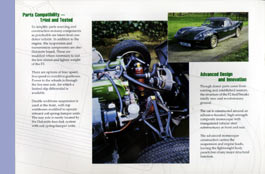 Parts
Compatibility — Tried and Tested Parts
Compatibility — Tried and Tested
To simplify parts sourcing and construction as many
components as practicable are taken from one donor vehicle.
In addition to the engine, the suspension and transmission
components are also Dolomite based. These are modified
where necessary to suit the low stance and lighter weight
of the F2.
There are options of four speed, five speed or overdrive
gearboxes. Power to the wheels is through the live rear
axle, for which a limited slip differential is available.
Double wishbone suspension is used at the front, with
top wishbones modified to operate inboard coil spring/damper
units. The rear axle is neatly located by the Dolomite
four-link system with coil spring/damper units.
Advanced
Design and Innovation
Though donor parts come from existing and established
sources, the structure of the F2 itself breaks totally
new and revolutionary ground.
The car is constructed around an adhesive-bonded, high-strength
composite monocoque with triangulated tubular steel
substructures at front and rear.
The advanced monocoque construction carries the suspension
and engine loads, leaving the lightweight body panels
free of any major structural function.
 Designed
to Perform Designed
to Perform
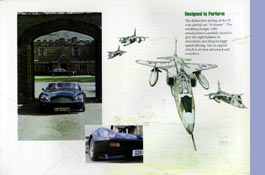
The distinctive styling of the F2 was carried out "in-house".
The resulting design, with aerodynamics carefully tuned
to give the right balance of downforce and drag for
high speed driving, has an appeal which is at once advanced
and evocative.
 Background
and Influences on Development Background
and Influences on Development
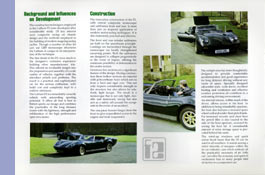
The construction techniques employed in the Latham F2
were developed after considerable study. Of key interest
were composite racing car chassis design and the methods
employed in the building of modern seagoing racing yachts.
Though a number of other kit cars use GRP monocoque
structures the Latham is unique in its interpretation
of the technique.
The
fine detail of the F2 owes much to the designer's extensive
experience building other manufacturers' kits. This
offered an invaluable insight into the preparation and
assembly of a wide variety of vehicles, together with
the attendant pitfalls and problems. The result is a
practical and sophisticated car for the serious enthusiast,
with build cost and complexity kept to a realistic minimum.
The Latham F2 is a remarkably versatile vehicle with
astounding sporting potential. It offers all that is
best in British sports car design and combines the practicality
of the long distance tourer with the lightness, strength
and exhilaration of the high performance open two-seater.
Construction
The innovative construction of the F2, with central
composite monocoque and subframes front and rear, is
more than just an inspired application of modern motor-racing
techniques. It is also immensely practical and effective.
The front and rear tubular subframes are built on the
spaceframe principle. Loadings are transmitted through
the monocoque via locally strengthened mounting points.
Both the subframes are designed to collapse progressively
in the event of impact, offering the minimum possibility
of deformation to the centre section.
Generous box sections are a significant feature of the
design. During construction these hollow sections are
injected with polyurethane foam which sets to form a
hard and rigid core. This not only imparts considerable
strength to the structure but also allows for relatively
light layups. The result is a monocoque that is not
only light, durable and immensely strong but also acts
as a safety cell around the occupants in the event of
an accident. The one-piece bonnet hinges from the front
to give unparalleled access to the engine and front
suspension.
The
cockpit area has been thoughtfully designed to provide
comfortable accommodation and good ergonomics for long
distance driving without any waste of space. Specially
designed adjustable seats, wide doors, excellent heating
and ventilation and effective weather protection all
contribute to welcoming driving environment. An internal
release, within reach of the driver, allows access to
the boot. I addition to being remarkably spacious, the
boot also features a recessed spare wheel well and under-floor
petrol tank. For increased security and clean lines
the petrol filler is also located to the side of the
boot aperture, accessed by raising the boot lid. A considerable
amount of extra storage space is provided behind the
seats. The wind-up windows and quick action hood mean
that the F2 can be used in all weathers. It stands among
a select minority of marques within the kit car industry;
cars which embody all the practicality necessary of
an 'only car', yet offer the economy and spirit of excitement
that so many people find attractive in a component car
 The
Kit The
Kit
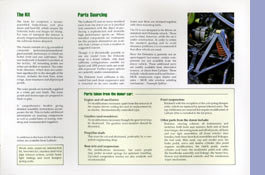
The basic kit comprises a factory-assembled body/chassis
unit plus doors and boot-lid, which require the Dolomite
locks and hinges for fitting. For ease of transport
the bonnet is already hinged and fitted to the front
of the subframe before despatch.
The
chassis consists of a jig-assembled composite (polyester
/ polyurethane / glass / aramid) monocoque to which
are bolted front and rear subframes. The rear bodywork
is bonded in position at the factory.
All
mounting points are either pre-drilled or marked. The
outer body structure, which does not contribute significantly
to the strength of the chassis, includes the boot floor,
inner wings, door structures and all principal panels.
The outer panels are normally supplied in a white gel
coat finish. The inner panels and monocoque are prepared
in black or grey.
A comprehensive booklet giving detailed assembly instructions
accompanies the kit. This includes additional information
on sourcing components as well as useful hints on tuning,
trimming and recommended suppliers.
Parts
Sourcing
The Latham F2 uses as many standard parts from the donor
car as is practical and consistent with the object of
producing a sophisticated and desirable high performance
sports car. Where standard components are inadequate
for this purpose alternatives are available from Latham
or from a number of suggested sources.
Though it is theoretically possible to use any model
from the Dolomite range as a donor vehicle, only front
subframe configurations suitable for Sprint and 1850
power units are available at present. Further engine
options are currently under consideration.
The Dolomite front subframe is discarded but each front
suspension unit is mounted on its own smaller subframe
and these are retained together with their mounting
bolts.
The F2 is not designed to be driven on standard steel
Dolomite wheels. These can be fitted, however, while
the car is under construction. In order to retain the
standard gearing and to avoid clearance problems it
is recommended that alloy wheels are used.
Since the Dolomite is patently not an open-topped two-seater,
certain components are not available from the donor
vehicle. These additional parts are readily available
from alternative sources, or direct from Latham. These
include: windscreen and hood frames-MGB; windscreen
wiper blades and arms – MGB; side window winding
mechanism - Triumph Spitfire.
Parts
taken from the donor car: -
Engine
and all ancillaries: No modifications necessary
apart from the removal of the engine-driven cooling
fan and its replacement by an electric, thermostatically
controlled type.
Gearbox
(and overdrive): No modifications necessary
though the gear lever may be shortened. The gearbox
cross member should be discarded.
Propellor
shaft: This must be cut and shortened, preferably
by a competent engineering shop.
Rear
axle and suspension: No modifications necessary,
but some people may prefer re-rated springs for optimum
handling. Up-rated competition bushes are also available
and recommended.
 Front
suspension: Retained with the exception of
the coil spring/damper units, which are replaced by
special inboard units. The top wishbones arc retained
but require modification at Latham (this is included
in the kit price). Front
suspension: Retained with the exception of
the coil spring/damper units, which are replaced by
special inboard units. The top wishbones arc retained
but require modification at Latham (this is included
in the kit price).
Other
parts from the donor include: Radiator; steering
column; all instruments and switches; both front seat
runners; both sets of front door hinges; the wiring
loom and all relays etc; all front and rear light assemblies;
all (four) interior door handles; both front door lock
assemblies and linkages; the fuel tank, filler neck,
cap and sender unit; the brake pedal, servo and master
cylinder (the pedal requires modification); the clutch
pedal, master cylinder and hose; the accelerator pedal
and cable; the handbrake assembly and linkage; the heater
box, blower and dashboard controls; and the windscreen
wiper mechanism.
In
addition to the basic kit the following extras are available
from Latham: Hood, seats, carpet set, interior
trim kit, boot trim kit, stainless steel twin pipe exhaust
system, acrylic headspring units.
To
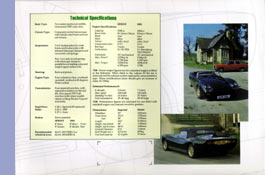
view the TECHNICAL SPECIFICATIONS of
the Latham F2, follow this link:
|