|

This
is a brief history of the Latham F2 Super Sports, with
links to some magazine articles and reviews.
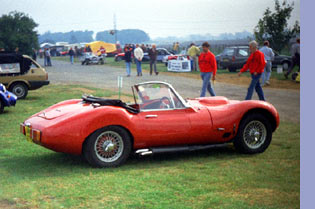 Conceived
during the mid-1980s, the F2 was the second car to be
produced by Latham Sports Cars. The company, founded
by husband and wife team of Paul and Julia Latham Jackson,
was originally based just outside Bicester, and it was
there that the Latham F1 was created. Just one example
of this two-seat open topped sports car was ever built,
since it was only ever seen as a precursor to their
true objective; the F2. Conceived
during the mid-1980s, the F2 was the second car to be
produced by Latham Sports Cars. The company, founded
by husband and wife team of Paul and Julia Latham Jackson,
was originally based just outside Bicester, and it was
there that the Latham F1 was created. Just one example
of this two-seat open topped sports car was ever built,
since it was only ever seen as a precursor to their
true objective; the F2.
In
order to fund the development of the new car, and to
find economically suitable premises in which to carry
out all the preliminary work, Latham Sports Cars relocated
to Julia’s home town of Penzance in Cornwall.
They found a small industrial estate between Newlyn
and Penzance, just behind a Mead factory and not far
from the old Pilchard works. The unit went under the
rather quaint name of Stable Hobba, and while the project
took up residence there, Paul and Julia moved into one
of the historic cottages on the old harbour front in
Newlyn. It was an idyllic location, but they were about
to embark upon some of the hardest and most demanding
years of their lives.
The
company exhibited a quarter-scale mock-up of the car
at the 1984 Stoneleigh show, and this generated sufficient
interest to reaffirm Paul’s belief in the future
of the car. Joined by another experienced car designer,
Andrew Dawkes, the company spent the next two years
perfecting the design, refining their drawings, and
constructing scale models and prototypes. The workshops
contained a variety of other influential cars, including
an Elva, a Davrian and, from time to time, a beautifully
built NG, but mostly it was a scene of industrious hard
work as Paul, Andrew and Julia toiled with paper and
plans, wood, resin and steel, and all to the accompaniment
of clouds of dust. 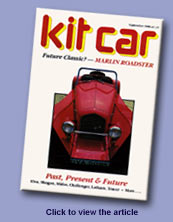
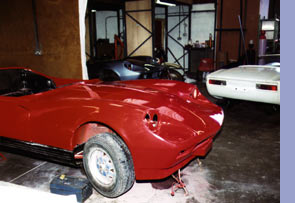
Then,
in the late summer of 1986, the company proudly unveiled
its creation. At this stage all they could display was
the completed ‘buck’ from which the body
moulds would be created, but suitably painted and with
wheels and windscreen strategically positioned, it looked
the part. An article appeared in Kit Car magazine, courtesy
of Ian Hyne, and three orders were taken on the back
of that showing alone.
 Thus
encouraged Latham Sports Cars moved back to Bicester,
taking over a factory previously used for the construction
of Indy racecars, and production began in 1987. Business
was brisk to begin with, and a succession of kits, part
built cars and even two fully road-ready turn-key examples
left the workshops. It soon became evident, however,
that the orders were not keeping pace with the bank
manager’s expectations. With development complete
– or nearly so - Paul was forced to look for another
source of income, and he left to join TWR in Kidlington,
where he became embroiled in the Jaguar XK8 and subsequently
the Aston Martin DB7 projects. His F2 was a significant
presence in the company car park. Andrew Dawkes joined
Triumph Motorcycles and then Volvo in Scandinavia, in
both cases with major roles in design and development.
That left Julia, with a staff of three, to oversee F2
production. Thus
encouraged Latham Sports Cars moved back to Bicester,
taking over a factory previously used for the construction
of Indy racecars, and production began in 1987. Business
was brisk to begin with, and a succession of kits, part
built cars and even two fully road-ready turn-key examples
left the workshops. It soon became evident, however,
that the orders were not keeping pace with the bank
manager’s expectations. With development complete
– or nearly so - Paul was forced to look for another
source of income, and he left to join TWR in Kidlington,
where he became embroiled in the Jaguar XK8 and subsequently
the Aston Martin DB7 projects. His F2 was a significant
presence in the company car park. Andrew Dawkes joined
Triumph Motorcycles and then Volvo in Scandinavia, in
both cases with major roles in design and development.
That left Julia, with a staff of three, to oversee F2
production.
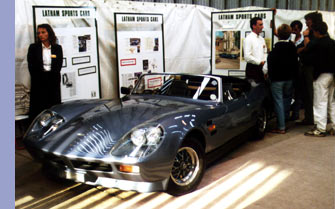 A
beautifully prepared example of the F2, RJB974M, was
built for one customer, but retained on long-term loan
by Latham Sports Cars to act as the company demonstrator.
For two years it did the rounds of the kit car shows
and magazine reviews, gaining accolades and plaudits
wherever it went. Sadly it was not enough. The hurdle
to success proved to be the complexity of the car’s
construction and the highly price-competitive nature
of the component car industry at that time. Customers
were not inclined to pay extra for technological innovations
they couldn’t see, despite the appealing shape
of the F2, and each car barely covered its production
costs. With the number of kits just topping the twenty
mark, Latham Sports Cars ceased trading. A
beautifully prepared example of the F2, RJB974M, was
built for one customer, but retained on long-term loan
by Latham Sports Cars to act as the company demonstrator.
For two years it did the rounds of the kit car shows
and magazine reviews, gaining accolades and plaudits
wherever it went. Sadly it was not enough. The hurdle
to success proved to be the complexity of the car’s
construction and the highly price-competitive nature
of the component car industry at that time. Customers
were not inclined to pay extra for technological innovations
they couldn’t see, despite the appealing shape
of the F2, and each car barely covered its production
costs. With the number of kits just topping the twenty
mark, Latham Sports Cars ceased trading.
What
made the F2 so difficult to build, and yet so radical,
was an all-composite monocoque – the first open-topped
road car ever to feature such a construction. With no
steel between the front and rear bulkheads the car was
remarkably light, and cars could be built with an all-up
weight of little more than 650 kilos. Fitted with Triumph’s
award-winning Dolomite Sprint 16-valve engine, performance
was exhilarating – to say the least! RJB974M took
part in two Track Days at Castle Combe circuit, and
in the right hands proved virtually unbeatable. Nothing
short of a Jaguar-engined Cougar or a race-tuned Cobra
replica could match it round the Wiltshire circuit.
The handling was superb, and the slippery shape, combined
with a Sprint engine generating over 185 bhp, gave back-slapping
acceleration and an awesome top speed.
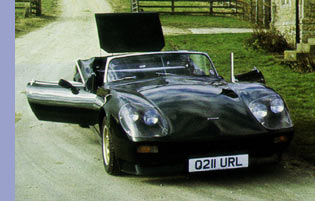 Had
things gone differently, then the future for the F2
might have been very different. Full type approval and
series production had always been the objective as far
as Paul Latham Jackson was concerned. The car had been
designed to comply with all the Type Approval requirements
of the day, and those kits that did leave the factory
were, in effect, merely prototypes. Vauxhall’s
two-litre “red top” engine was earmarked
for the production car’s engine bay, dry sumped
and mated to a Sierra five-speed gearbox using an adaptor
bellhousing. A Ford independent rear suspension system
was also envisaged, with disc brakes all-round, plus
an option to turbocharge the engine. Within a few years,
Caterham would offer exactly this installation option
for the Seven, but by then the Latham would have been
long out of production. Had
things gone differently, then the future for the F2
might have been very different. Full type approval and
series production had always been the objective as far
as Paul Latham Jackson was concerned. The car had been
designed to comply with all the Type Approval requirements
of the day, and those kits that did leave the factory
were, in effect, merely prototypes. Vauxhall’s
two-litre “red top” engine was earmarked
for the production car’s engine bay, dry sumped
and mated to a Sierra five-speed gearbox using an adaptor
bellhousing. A Ford independent rear suspension system
was also envisaged, with disc brakes all-round, plus
an option to turbocharge the engine. Within a few years,
Caterham would offer exactly this installation option
for the Seven, but by then the Latham would have been
long out of production.
Although
Paul’s dream would never be realised, there’s
no doubt the Latham F2 could have become an amazing
production road car. His inspiration came from many
quarters, as his own telling of this story suggests,
but the combination of a pinch of Jaguar E-type with
a hint of Marcos, some Aston Martin perhaps, and a generous
dose of other wholly unique yet classic lines, created
a stunning and inherently “British” sportscar.
Also
see Paul latham Jackson's own account of how the F2
was born by following this link
|