| 
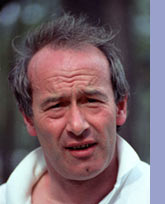 Paul
(Latham-Jackson) is often asked about the history behind
the F2; how and why it came to be designed and eventually
produced. This is his account of the story - currently
with few pictures, but more will be added shortly. It
was written in late 1990, but we have not altered his
words to reflect the passage of time. . . . . Paul
(Latham-Jackson) is often asked about the history behind
the F2; how and why it came to be designed and eventually
produced. This is his account of the story - currently
with few pictures, but more will be added shortly. It
was written in late 1990, but we have not altered his
words to reflect the passage of time. . . . .
"I
have been fortunate enough to have driven a wide variety
of some of the best sports cars produced since the war;
ranging from competition Ferraris down to the humblest
and tattiest of Spridgets and 'fifties Ford and Austin
specials. I've always had a soft spot for the products
of Lotus and Jaguar, but they have usually been too
expensive for me to own a really good example of either.
Like
many enthusiasts, I was disappointed when impending
American legislation threatened the future of the traditional
open-top two-seater. The development of the front-engined
sports car also came to a grinding halt when mid-engine
configuration became fashionable in the 'sixties. The
mid-engined road burners that followed always had a
crouching aggression that was most attractive, but for
reasons of space utilisation, gearbox type and position
and tyre fashion, they were less practical, generally
more expensive and rarely as elegant as the more traditional
roadsters and sports tourers.
The
driver appeal had changed too. On the race track - smooth
surfaced and built for flat-out competition driving
- the last iota of handling and roadholding must be
extracted from the complex system that is a race car
chassis. At much lower touring or even fast road driving
speeds, such cars are often unsuited to the unpredictable
road surfaces, narrow lanes and changeable weather that
so often seems to be part and parcel of the joyous experience
of driving a good car on the open road.
I
am a great believer in the old adage that racing improves
the breed, but I also believe that when racing cars
became primarily mid-engined and wide tyred they were
so far removed from road vehicles that it became difficult
to see how they were going to benefit the sporting road
driver. Of course there have been some desirable mid-engined
cars - who would deny the appeal of the Lamborghini
Muira or the Ferrari 308 GTB? - but they have tended
to be at the more expensive end of the market. When
Porsche (who have won an awful lot of sports car races!)
decided to produce a new generation of roadgoing sports
cars to replace their ageing 911 series, the 924 and
928 cars appeared with their engines at the front.
Of
course there have been other front-engined sports cars
produced since the 'sixties. Alfa Romeo soldier on still
with the Pininfarina bodied Spyder: a lovely body (designed
by the people responsible for the Daytona Ferrari) around
a competent chassis and desirable engine, but hardly
the car for Everyman! The Fiat 124 Spyder was a pleasant
sporting tourer but not for sale in the UK.
Here
in England we produced the TR7. I've always liked TRs
and looked forward to the announcement of the TR7, but
why, oh why, didn't they produce it with a soft-top
and Sprint engine in the first place? By the time these
options were available, the poor car had already established
itself (unfairly, I think) with a reputation as an emasculated
poseur's car. Part of the problem was undoubtedly the
American regulations, with their insistence on high,
indestructible bumpers and fears of acid rain, but the
main problem, I'm certain, was the body design. The
TR7 looked great from the front, but after that it turned
into a poorly executed pastiche of a mid-engined car.
Things
went a bit quiet after that, apart from Morgan filling
up their waiting lists and TVR producing the angular
Tasmin. Then Reliant turned out the SS100; with a body
designed (apparently!) by Michelotti, who should really
have known better, but with strong TR7 overtones and
lots of unnecessary detail moulding. They have since
learned their lesson and revised the body mouldings
to smooth out the shape and improve the car's appearance
immeasurably, though possibly too late to salvage dwindling
sales.
In
the meantime, the kit car industry had gathered a large
band of followers, mostly unhappy with what the mass
manufacturers were turning out. Not everyone wanted
to restrict their sporting motoring to a shopping car
with extra stripes or even a soft top, and few could
afford the silly prices beginning to be asked for the
older sporting machinery. By the late 'seventies any
five year old car was already beginning to rust very
badly. The kit car boom enabled the young man without
a fortune to put together an exciting open bolide using
the perfectly reliable mechanical bits from the decaying
family car. Lets face it; MG, Jaguar and Lotus all started
in a similar way. The problems with most of the early
'eighties kit cars was that they were so unrefined.
A doorless cramped machine with a massive ladder chassis
is fine for a few summer afternoons, but after a rainy
trip of a few hundred miles the appeal begins to wane.
At
this time I had left my work in motor racing and was
running the Specialist Cars workshop in Oxfordshire
in partnership with my wife, Julia. We spent some time
repairing and rebuilding the odd Lotus, Marcos or Ginetta,
but most of our business was building new kit cars for
people who had neither the time nor the facilities to
do it themselves. We built several of the better types,
such as Marlin and NG, and a few less delightful products
from manufacturers who shall remain nameless.
It
was during this time that the germ of the F2 idea began
to take shape. Because we were not aligned with any
one kit manufacturer, many potential customers would
ask our advice about which kits to consider, and it
soon became apparent that there was a significant demand
for something more sophisticated than the 'thirties
replicas that were so prevalent at the time. It couldn't
be a replica because most of the people involved knew
quite a lot about car history and didn't really want
to admit that they were driving a copy of something.
They wanted the real thing, and it had to be practical,
good looking, fast and relatively cheap to buy, so that
more money could be spent on things like leather seats
and decent wheels and tyres.
After
a lot of thought and nattering we came up with a basic
specification. The car would have to be an open two-seater
but with room behind the seats for the odd baggage or
baby. There would have to be adequate and simple weather
equipment and a boot sufficiently large and secure enough
for a couple of weeks' continental touring. In order
to propel this package along sufficiently rapidly we
would need something around 100 bhp minimum, and the
car would have to be low and smooth enough not to cost
a fortune in petrol.
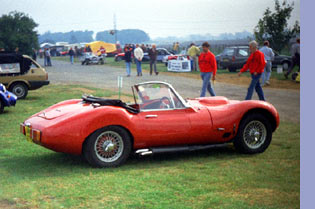 We
prepared an exploratory prototype using an old TR4 chassis
and a heavily modified 1950's bodyshell and it was very
well received at Stoneleigh that year. We had obviously
got the formula right but we had to find a more suitable
donor car and re-design the slightly ungainly body so
that it was completely original, more practical and
a lot prettier. There was also the question of the chassis.
The TR frame was rather flexible without its steel bodyshell
so we had strengthened the GRP shell with foam-filled
sills and a massive rear bulkhead that incorporated
the aluminium fuel tank. There was also a strong tubular
steel hoop bolted through to the chassis and extending
across the car behind the dashboard. The body itself
formed a very rigid monocoque, and when it was bolted
to the TR chassis with the engine moved six inches back
the whole assembly was far more stiff than I'd expected.
I began to wonder if we could do without the chassis
entirely. We
prepared an exploratory prototype using an old TR4 chassis
and a heavily modified 1950's bodyshell and it was very
well received at Stoneleigh that year. We had obviously
got the formula right but we had to find a more suitable
donor car and re-design the slightly ungainly body so
that it was completely original, more practical and
a lot prettier. There was also the question of the chassis.
The TR frame was rather flexible without its steel bodyshell
so we had strengthened the GRP shell with foam-filled
sills and a massive rear bulkhead that incorporated
the aluminium fuel tank. There was also a strong tubular
steel hoop bolted through to the chassis and extending
across the car behind the dashboard. The body itself
formed a very rigid monocoque, and when it was bolted
to the TR chassis with the engine moved six inches back
the whole assembly was far more stiff than I'd expected.
I began to wonder if we could do without the chassis
entirely.
By
that time I had spent a couple of years driving a Davrian
as my personal car. The Davrian is a tiny streamlined
coupe with a Hillman Imp engine stuck in the back. They
were (and still are! ) immensely successful in Modsports
racing and just about the only things that could beat
them consistently were highly modified Lotus Elans.
The
Davrian also had a glass-fibre monocoque. Large section
sills were filled with hard-set polyurethane foam and
connected by thick GRP bulkheads and glass/plywood sandwich
floors. It worked perfectly. The only question was whether
the same principles could be applied to a rather larger
structure with a heavier engine. Careful study of composite
race car chassis and the foam-filled hulls of modern
racing yachts convinced me that it was not only possible,
but likely to be a far more practical method of construction
than the space frame.
Space
frames are wonderful for competition cars. They are
relatively simple to make (not easy to design though!),
very strong and simple to repair. Their main drawback
is that they do not keep the weather out. By their very
nature they define the areas of the car into engine
bay, passenger compartment etc, but then need panels
rivetted or glued into position to form bulkheads, floors
and footwells etc.
Our
experience at Specialist Cars had taught us that the
best way to make a cockpit weatherproof was to incorporate
the entire floor, sides and front and rear bulkheads
in one moulding which is almost impossible with a true
spaceframe. The monocoque lends itself very well to
this type of unitary construction approach!
Having
chosen - or rather, been presented with - the most suitable
construction technique, a suitable donor car had to
be chosen before we could carry on with the detail design
of the centre section. As the car was initially to be
produced in kit form, which means that the purchaser
has to find his own mechanical parts, we drew on our
Specialist Cars experience once again and decided that
it was essential to take all the component parts from
one donor vehicle. This would avoid asking people to
collect together a series of previously unrelated parts.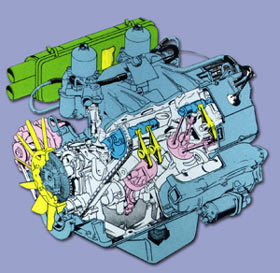
It
didn't take long to select the Triumph Dolomite, with
its well-located live rear axle, overdrive gearbox and
the wonderful 16-valve engine of the Sprint as an option.
With the exception of an oil pressure gauge it even
had a good set of instruments. I was initially worried
by the engine's reputation for overheating, but after
talking to a number of people who knew the engine well
I realised that it was something that could be overcome
with a little care and attention to detail. It is amazing
how a car can get a tainted reputation in the first
few months of its production life, and that taint will
stay with it long after the problem has been solved
- and even after the car has gone out of production.
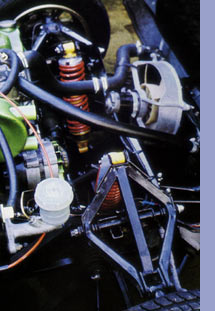 The
only real problem with the Dolomite was the front suspension.
Firstly; the spring/damper units are mounted above the
top wishbone assembly, which means that they go far
too high for the low bonnet line I had envisaged for
the F2, and secondly; the steering rack is mounted behind
the front axle line rather than in front. This means
that if the engine were to be lowered in relation to
the front suspension it would also have to move a long
way back in the chassis. This in turn leads to complications
in the design of the exhaust system where it tries to
go through the passenger footwell. Both problems could
have been overcome by using front suspension units from
the Triumph Herald or Spitfire, but this would of course
have meant more cost to the customer. So we decided
to stick with the Dolomite parts and make them work. The
only real problem with the Dolomite was the front suspension.
Firstly; the spring/damper units are mounted above the
top wishbone assembly, which means that they go far
too high for the low bonnet line I had envisaged for
the F2, and secondly; the steering rack is mounted behind
the front axle line rather than in front. This means
that if the engine were to be lowered in relation to
the front suspension it would also have to move a long
way back in the chassis. This in turn leads to complications
in the design of the exhaust system where it tries to
go through the passenger footwell. Both problems could
have been overcome by using front suspension units from
the Triumph Herald or Spitfire, but this would of course
have meant more cost to the customer. So we decided
to stick with the Dolomite parts and make them work.
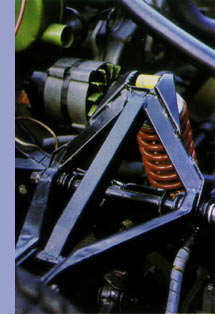 The
solution to the first problem is, I think, particularly
ingenious and has since become quite a feature of the
F2 design: The lower ball joint is not designed for
the sort of loading that would be imposed if we were
to mount the spring/damper unit on the lower wishbone,
even if there was anywhere suitable to mount it. Also,
since the engine had to be moved so far back to keep
the bonnet line down, there was now a large gap between
the radiator and the front of the engine. It seemed
an ideal place to put the springs and dampers; well
inboard and operated by rocker arms just like a modern
Formula One car! The rockers could be fabricated using
the original top wishbone pressings as a base and be
offered on exchange as part of the kit. The
solution to the first problem is, I think, particularly
ingenious and has since become quite a feature of the
F2 design: The lower ball joint is not designed for
the sort of loading that would be imposed if we were
to mount the spring/damper unit on the lower wishbone,
even if there was anywhere suitable to mount it. Also,
since the engine had to be moved so far back to keep
the bonnet line down, there was now a large gap between
the radiator and the front of the engine. It seemed
an ideal place to put the springs and dampers; well
inboard and operated by rocker arms just like a modern
Formula One car! The rockers could be fabricated using
the original top wishbone pressings as a base and be
offered on exchange as part of the kit.
Having
established this new relationship for the Dolomite parts
we then had an approximate outline around which to design
the body. Many people have asked me what influenced
the shape of the Latham and whether it is supposed to
look like some previous design. It isn't. Nor is it
intended to recreate the spirit of the fifties sports
racer or sixties road car. Most of the design decisions
on the bodywork were predetermined by our initial parameters,
the requirements of practicality, or the Construction
and Use Regulations which effect all cars to be driven
on public roads in this country. Certainly there have
been particular cars that I have admired, and most people
have been able to detect styling influences from one
period or another in the F2. But rather than borrowing
features from other cars I tended to study the way in
which their designers had overcome particular problems
and then apply these to my own design situation.
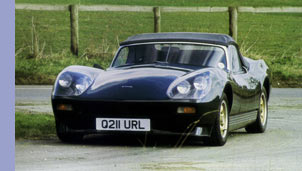
Headlights
were covered with plastic fairings rather than being
retractable in order to save cost and complication.
As many parts from the donor car as possible were used,
except where they were likely to compromise the sporting
character of the Latham, and that decision in itself
determined a great many of the design details; from
the type of lights we used to such things as door handles,
locks, instruments, pedals etc. So, as the various parts
were put into place the number of design decisions became
fewer, until I felt that I'd hardly designed the car
at all - I had just uncovered something that was already
there!
 So,
there you are! The Latham F2 has now been designed and
built. Some people may not like the design - it isn't
perfect for me, so it's unlikely to be perfect for everyone
else, but a lot of thought and hours of development
went into arriving at the unique character and visual
appeal of the F2. Combined with this is its immense
performance potential and the practical detailing that
makes it as suitable for driving to the office every
day as for setting out on a tour of Europe for a few
weeks. Perhaps most important of all; when someone asks
you what you're driving you don't have to say "a
kit car", or "a GT40, but it's only a replica".
You can look them in the eye and say (proudly?) that
it's "a Latham - come and have a look!" So,
there you are! The Latham F2 has now been designed and
built. Some people may not like the design - it isn't
perfect for me, so it's unlikely to be perfect for everyone
else, but a lot of thought and hours of development
went into arriving at the unique character and visual
appeal of the F2. Combined with this is its immense
performance potential and the practical detailing that
makes it as suitable for driving to the office every
day as for setting out on a tour of Europe for a few
weeks. Perhaps most important of all; when someone asks
you what you're driving you don't have to say "a
kit car", or "a GT40, but it's only a replica".
You can look them in the eye and say (proudly?) that
it's "a Latham - come and have a look!"
Paul
Latham-Jackson
|