| 
 In
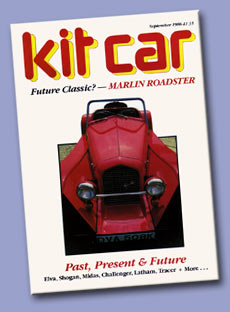
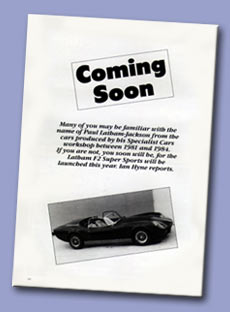
1986 Ian Hyne of Kit Car Magazine "tracked down
the potentially superb Latham Sports". This is
what he had to say . . . In
1986 Ian Hyne of Kit Car Magazine "tracked down
the potentially superb Latham Sports". This is
what he had to say . . .
Visitors
to the 1984 Stoneleigh show may remember a prototype
body for a forthcoming sportscar displayed on the Latham
stand, but it would be quite understandable if you had
forgotten it, for it would not be the first time that
a project in prospect had bitten the dust in the early
stages of development. But not so the Latham F:2 Super
Sports, for although news of its progress has been scant,
the last two years have witnessed intensive development
at the company's new, secluded premises near Penzance
in Cornwall.
The idea was to produce a truly original, two seater
sports car embodying the most modern methods of design
and construction. In that, Paul has been successful,
on top of which he has produced a car of beauty, practicality,
safety and driver appeal.
 It
is an advanced car incorporating a number of sophisticated
structural features developed in motor racing. The basis
of the car is a central, composite monocoque of immense
strength and torsional rigidity. These qualities are
achieved by the floors and the bulkheads being of double
skinned, honeycombed construction while the large sill
sections are filled with hard plastic foam and sturdy
steel anti intrusion beams. As well as lending tremendous
strength, these materials are also extremely light. It
is an advanced car incorporating a number of sophisticated
structural features developed in motor racing. The basis
of the car is a central, composite monocoque of immense
strength and torsional rigidity. These qualities are
achieved by the floors and the bulkheads being of double
skinned, honeycombed construction while the large sill
sections are filled with hard plastic foam and sturdy
steel anti intrusion beams. As well as lending tremendous
strength, these materials are also extremely light.
To the front and rear of the centre section are bolted
tubular steel subframes designed to feed road stresses
into the central monocoque where they are dissipated.
This method of construction is similar to that employed
in the design of both the E type Jaguar and Ford GTD
40.
The
car utilises the engine and mechanical components of
the Triumph Dolomite and Dolomite Sprint models, the
latter providing a 2 litre engine with four valves per
cylinder resulting in an estimated performance of 0-60
in 7 seconds and a top speed of 125 mph while giving
fuel consumption of around 25 mpg.
 The
rear suspension utilises the Triumph axle located by
four trailing arms and telescopic dampers while at the
front the Triumph set up is altered to use lower wishbones
and top rocker arms with inboard telescopic-dampers. The
rear suspension utilises the Triumph axle located by
four trailing arms and telescopic dampers while at the
front the Triumph set up is altered to use lower wishbones
and top rocker arms with inboard telescopic-dampers.
The unstressed body will be available in either GRP
or 16 SWG hand formed aluminium and, while being a unique
design, for me, it is highly reminiscent of the Toyota
2000 GT; I've still got my Corgi James Bond one that
fires little yellow plastic rockets out of the boot
— I wonder where he put his suitcase?
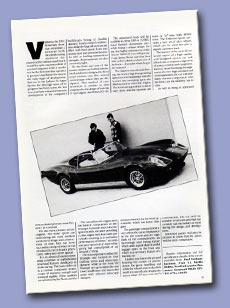 The
shape is smooth and flowing, the front wings incorporating
faired in twin headlamps and the bonnet line sweeping
up to the MGB screen to cover the wipers. The doors
are a good size to allow easy entry and incorporate
aluminium channels for the wind up windows which use
Lotus Elan glass. The
shape is smooth and flowing, the front wings incorporating
faired in twin headlamps and the bonnet line sweeping
up to the MGB screen to cover the wipers. The doors
are a good size to allow easy entry and incorporate
aluminium channels for the wind up windows which use
Lotus Elan glass.
The passenger compartment is very low in the car as
emphasised by the low screen and the high back of the
compartment; an increasingly used styling feature which
adds a great deal of useful luggage space to the boot
area which is a necessary feature of a touring car.
It is also very low to the ground, keeping the centre
of gravity down for good handling, and while the wheels
may look a little small, it is specifically designed
to run on either 13" rims with 185/70tyres or 14"
rims with 185/60 tyres. The Dolomite Sprint provides
a nice set of alloy wheels which can be used but give
a slightly narrower track.
The interior of the car is all one would expect of a
high quality, well-designed sports car and affords the
occupants a high level of space, comfort and equipment.
Indeed, detail finishing throughout is of a very high
standard and when launched, the car will justifiably
warrant comparison with the best cars the industry has
to offer.
 As
well as being of advanced construction, the car will
be available in kit form and Paul has certainly had
the builder in mind during the design and development.
Interested parties will also he pleased to know that
the prices will be most competitive. As
well as being of advanced construction, the car will
be available in kit form and Paul has certainly had
the builder in mind during the design and development.
Interested parties will also he pleased to know that
the prices will be most competitive.
Further information and full specification details of
the car are available from . . . .
Return
to Brief History 
With
thanks to Ian Hyne
Kit Car Magazine, September 1986, pages 24/25
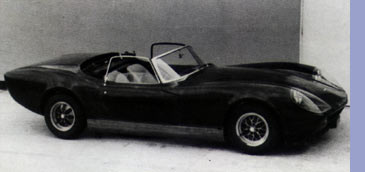
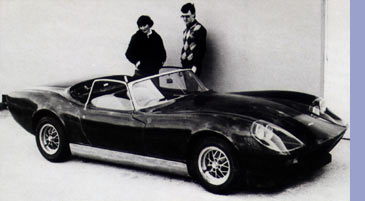
This
article was based on Ian's viewing of the development
buck from which the body moulds would subsequently be
taken. Look closely at the image above and you can just
see the castors at either end of the cill sections,
one just behind the front wheel, the other just ahead
of the back, of the trolley supporting what was, in
effect, a full scale wood and resin model.
Certain
features hinted at in the text never appeared in the
finished car. The cill sections never contained steel
beams, and the forward bulkhead, like the cills, was
of double skinned composite construction injected with
rigid foam - the aluminium honeycomb proved less effective
in practice and was deemed unnecessary. Aluminium bodypanels
were also never offered, even as an option, and the
F2 had its own uniquely-shaped side windows, without
the full-frame Elan surround. Everything else, however,
duly came to pass . . .
|